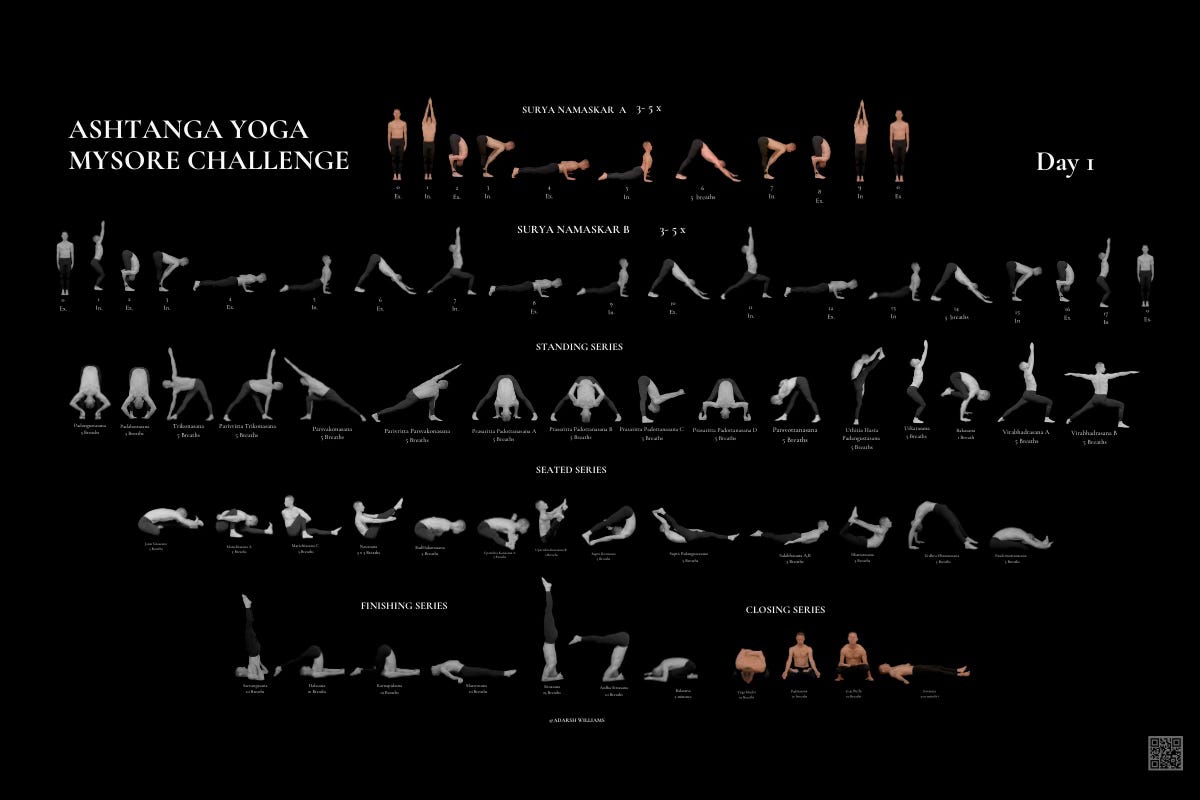

Surya Namaskar A & Closing Series
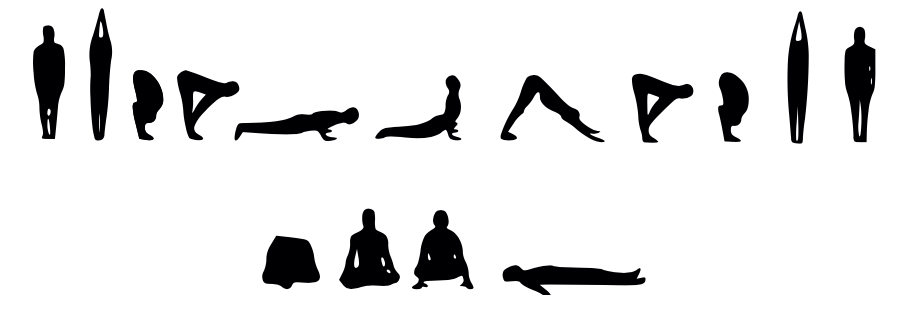
MYSORE CHALLENGE DAY 1 FOLLOW ALONG VIDEO
Surya Namaskar A, or Sun Salutation A, is the foundational sequence in Ashtanga Yoga and many other styles of yoga. The Sun Salute warms-up the muscles and fascia while moving the joints through a full range of motion, gently stretching the body and increasing circulation. This flowing sequence consists of a series of postures that are linked with the breath, designed to activate the entire body while cultivating focus and mindfulness.
More than a warm-up, in traditional yoga practice, Surya Namaskar is performed in honor of the sun, symbolizing vitality, renewal, and gratitude for life’s energy. In India, Sun Salutations are still performed at sunrise as a form of ritual worship. In yoga, it is believed that Surya, the Sun, is the source of all life. Each movement in the Sun Salutation sequence mirrors the cyclical nature of day and night, symbolizing renewal and growth.
Benefits of Surya Namaskar A:
Functional Movement Benefits:
Full-body engagement: Activates major muscle groups in the body, including the center, legs, arms, and back. It improves flexibility, balance, and coordination. Dynamic range of motion: The sequence incorporates forward bending, back bending, and strength-building movements, promoting joint mobility and stability.
Posture improvement: By engaging the midsection and back muscles, Surya Namaskar A encourages better posture and spinal alignment.
Health Benefits:
Increased circulation: The flowing movements, combined with deep breathing, stimulate blood flow, energizing the body and delivering oxygen to muscles. Cardiovascular health: Performing multiple rounds can elevate the heart rate, improving cardiovascular endurance.
Digestive health: The gentle abdominal compression during forward folds stimulates digestive organs and aids in detoxification.
Effects on Mind and Meditation:
Mindful movement: Surya Namaskar A encourages the synchronization of breath and movement, fostering mindfulness and concentration.
Mental clarity: The steady rhythm of breath in combination with flowing movement helps calm the mind, reducing stress and anxiety.
Meditative focus: Practicing the sequence repeatedly encourages moving meditation, helping to center the mind and cultivate inner awareness.
Traditional Yoga Benefits:
Honoring the sun: Traditionally, this sequence is viewed as a gesture of gratitude toward the sun, representing life force and energy.
Grounding practice: It connects the practitioner to the earth (through grounded standing postures) and the heavens (through reaching upward), balancing energy within the body.
Tips for Surya Namaskar A:
Progression:
Start slow: If you're new to the practice, begin with fewer rounds, move slowly, and focus on perfecting each movement. As you build coordination, strength and flexibility, increase the pace of your movements.
Work on alignment: Pay attention to alignment in foundational postures such as Chaturanga Dandasana and Urdhva Mukha Svanasana (Upward Facing Dog) to avoid strain.
Master the breath: Coordinate each movement with your breath. Inhale as you extend, and exhale as you fold or contract. This will help you find flow and rhythm.
Common Problems or Misalignments:
Overarching the lower back in Upward Facing Dog: Keep your midsection engaged and lengthen through the spine to avoid collapsing into the lower back.
Rushing through transitions: Focus on smooth, controlled movements rather than speeding through the sequence. The breath should guide the movement. Hyperextension of elbows in Plank or Chaturanga: Engage the triceps and core to stabilize the arms. Avoid locking the joints, which could lead to strain or injury.
Progressing the Pose:
Advanced breath control: Once you are comfortable with the flow of the movements, begin to explore advanced breath control (Ujjayi breath), which will allow for more controlled energy expenditure.
Add repetitions: Increase the number of rounds gradually to build stamina and deepen your practice.
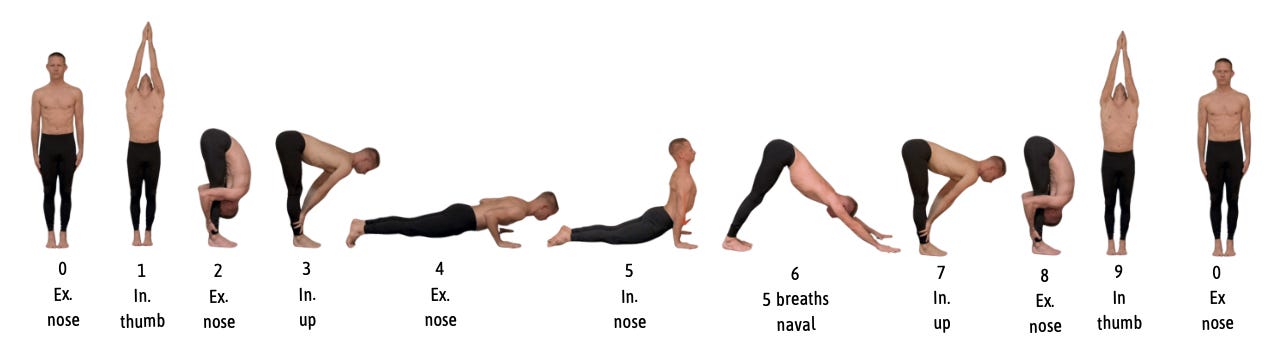
Surya Namskar A - Vinyasa Sequence 9
Start in Samasthiti : Stand with your feet together, arms at your sides, and focus on
your breath.
1.EKAM: Inhale as you raise your arms overhead, bringing your palms together. Look up to your thumbs.
2.DVE: Exhale as you bend forward, hinging at the hips, into Uttanasana (Standing Forward Bend). Try to press the floor with your hands or fingers.
3.TRINI: Inhale, lift your head and chest to lengthen your spine into Ardha Uttanasana (Halfway Lift). Keep your gaze forward.
4.CATVARI: Exhale, jump or step back to Chaturanga Dandasana (Four-Limbed Staff Pose). Keep your body in a straight line and elbows close to your body.
5.PANCHA: Inhale, pull forward into Urdhva Mukha Svanasana (Upward-Facing Dog). Straighten your arms and lift your chest, keeping your shoulders down.
6.SAT: Exhale, push back into Adho Mukha Svanasana (Downward-Facing Dog). Keep your hips lifted and heels pressing toward the floor. Stay here for 5 breaths.
7.SAPTA: Inhale, jump or step forward to Ardha Uttanasana (Halfway Lift). Keep your spine long and gaze forward.
8.ASTAU: Exhale, fold back into Uttanasana (Standing Forward Bend). Allow your head to move toward your knees.
9.NAVA: Inhale, stand up and raise your arms overhead, palms together. Look up to your thumbs.
SAMASTHITI: Exhale, bring your arms back to your sides, returning to the standing position.
Surya Namaskar A is repeated 3-5x to begin your practice.
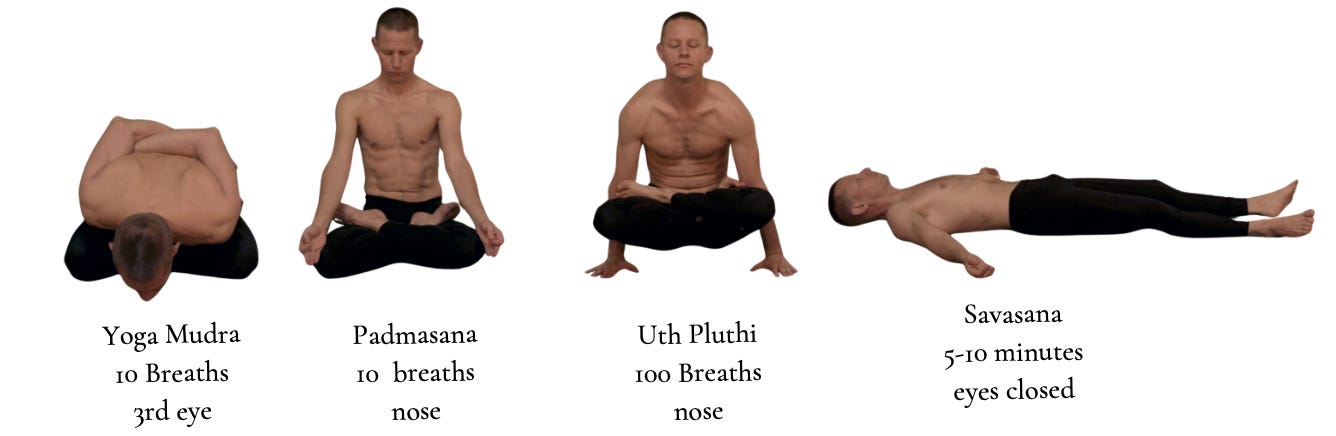
Closing Series - Vinyasa Sequence 11
1.EKAM: Inhale, raise your arms overhead, and bring your palms together. Look up to your thumbs.
2.DVE: Exhale, bend forward into Uttanasana (Standing Forward Bend).
3.TRINI: Inhale, lift your head and chest to Ardha Uttanasana (Halfway Lift). Keep your spine long.
4.CATVARI: Exhale, jump or step back into Chaturanga Dandasana (Four-Limbed Staff Pose).
5.PANCHA: Inhale, transition to Urdhva Mukha Svanasana (Upward-Facing Dog). Straighten your arms, lift your chest, and keep your shoulders down.
6.SHAT: Exhale, roll back into Adho Mukha Svanasana (Downward-Facing Dog). 7.SAPTA: Inhale, jump through and sit on the mat. Prepare for Padmasana (Lotus Pose). Cross your right leg, then left, placing each foot on the opposite thigh.
8.Yoga Mudra: From Padmasana, bring your left hand, then right, behind your back, clasp your toes, and exhale as you fold forward, allowing your forehead to touch the floor or as close as possible. Hold for 10 breaths, focusing on deep, steady breathing.
9.Padmasana: Return to an upright position in Padmasana. Place your hands on your knees, with your thumb and index finger touching (Jnana Mudra). Hold for 10 breaths, focusing on deep ujjayi breathing and gazing down the nose.
10.Uth Pluthi: Place your hands beside your hips and lift your entire body off the ground, balancing on your hands while still in Padmasana. Hold for 10 - 100 breaths.
11.Savasana: After completing Uth Pluthi, lie down on your back for Savasana (Corpse Pose). Allow your body to relax completely, with your arms resting by your sides and your legs spread slightly. Breathe deeply and calmly, letting go of any tension. Stay in Savasana for at least 5 minutes, or longer if needed, to fully relax and recover.
Tips for Closing Series:
Sit comfortably in Padmasana: If Padmasana is uncomfortable, sit in a modified cross-legged position, gradually working toward the full lotus position.
Progress Uth Pluthi: If lifting the entire body is challenging, start by lifting just the hips, gradually increasing strength to lift both feet off the floor.
Completing Your First Practice
How was your first practice?
Were you filled with excitement to begin something new, or is this a return to the mat? Either way, yoga has a way of making us feel something. To deepen the integration of your yoga practice, it's helpful to take a moment each day to reflect on your time on the mat. Ask yourself:
How I do feel today (physical, mental, emotional)?
What did I notice in practice today? Was it easy or difficult? What were the obstacles? What were the successes?
Some days will naturally feel easier than others. It's normal to feel stiff on some days, while on others, you may feel light and free. You'll quickly notice how lifestyle and environmental conditions affect your practice. This is a great opportunity, without judgment, to observe how these factors influence your body and mind.
Perhaps you begin to notice:
How did I sleep last night? How did the foods or drink effect my practice today?
This self-awareness starts as a study of the body and breath but soon expands into a more refined observation of the world around you.
Remember, the purpose of the Mysore Challenge is to build consistency. Your daily practice will help you stay grounded as you gain insights along the way.
There’s an old saying from the East that captures this perfectly: “Know the Way broadly and see it in all things.”
Mysore Challenge Day One Poster